The A2A protocol: how AI agents work with each other
A2A is an open protocol that lets AI agents from different suppliers find each other and hand over tasks. That makes agents more useful, and it makes the question of on whose behalf they act more important.
 iSearch
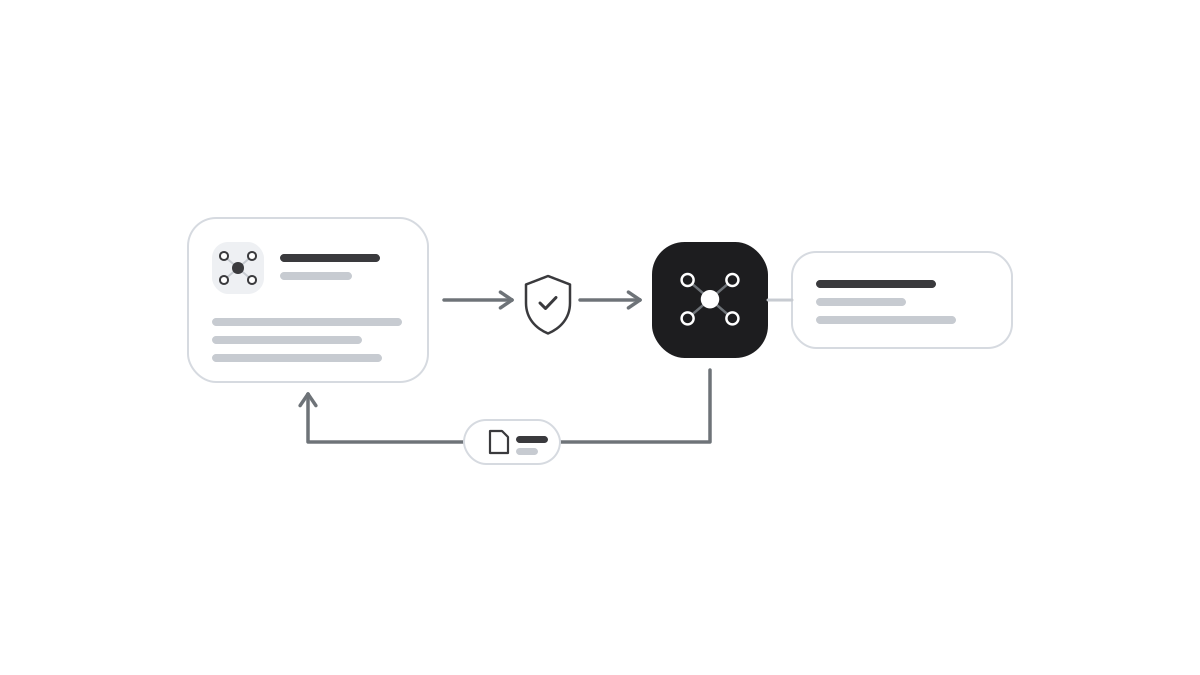
Say a new member of staff starts on Monday. The HR agent needs to set up the employment record, the IT agent needs to create accounts and a third agent needs to find the right onboarding material. Today most such agents work separately, each in its own system. For them to work together, someone has to build a connection between every pair.
That is the problem A2A is meant to solve.
What is A2A?
A2A, short for Agent2Agent, is an open protocol. A protocol is a shared set of rules for how software communicates, rather like a common language. With A2A, agents from different suppliers can find each other, divide up the work and return results.
A2A is easily confused with MCP. MCP describes how an AI agent uses tools and data, much as a member of staff looks something up in a database or uses a program. A2A describes how one agent asks another for help, more like handing a task to a colleague who decides for themselves how to do the work. A system can use both.
Google launched A2A in April 2025, and in June that year it was handed over to the Linux Foundation, a non-profit that looks after open-source projects and open standards independently of any single supplier. The first stable version arrived in March 2026, and a year after its launch the protocol was supported by more than 150 organisations.
How it works
Each agent publishes an agent card, a short description of what it can do, where it can be reached and how to sign in to it. In the example, the HR agent reads the IT agent’s card, signs in and sends the task of creating accounts for the newcomer.
The task follows a clear course. It is received and worked on, and it can be completed, fail or wait for more information. If the IT agent needs to know which department the newcomer belongs to, it asks back. With longer tasks, the agent can report on progress along the way.
Agents do not have to reveal how they work internally. The HR agent is told that the accounts exist but does not see the IT agent’s tools, memory or material. That makes it possible to work together without handing over more than the task requires.
On whose behalf?
When a member of staff asks an AI assistant, the system knows who is asking and what that person may see. When one agent asks another, the recipient sees the agent, and the person it works for can drop out of the picture.
A risk that is easy to overlook is that the answering agent uses its own access, which is often wider than that of the person asking. A simple question could then return material the person asking may not see. Permissions therefore need to be checked for the person the agent works for, and each agent should have only the access the task requires, in line with the principle of least privilege.
A2A relies on established sign-in methods such as OAuth, a common standard for giving software limited access on someone’s behalf, and mutual TLS, where both sides prove who they are before the connection opens. Agent cards can also be digitally signed, so that it is possible to check who published them. What an agent may then see is decided by the systems behind it.
The answer from another agent is also text, and text can contain hidden instructions that try to steer the recipient. A forged agent card could lead an agent to hand a task to the wrong recipient. Read more about the risks of AI agents.
When it becomes relevant
For many organisations, A2A is not yet the first question. The protocol becomes relevant when you have several agents in different systems that need to work together, or when a supplier wants to connect its agent to yours. Start with what applies to every AI tool: what the agent may do, which material it reads and who approves actions that cannot be undone.
When it does, the supplier should be able to answer a few things. Which agents should the system be able to communicate with, and who approves new connections? How can you see on whose behalf a question is asked, and how is each task logged? Where is the information sent between agents processed, and how long is it kept?
How it works in iSearch
In iSearch you set up assistants for a particular task, and each assistant reads only the documents you have connected to it. Permissions are checked before an answer is produced, so the assistant answers only from what the user is allowed to see. Role-based access controls what each person can reach, answers show which sources they are based on and a tamper-evident audit log shows who did what. The whole chain can run on your premises, or we run it for you in Sweden.
Read more about what an AI agent is and about security, or book a walkthrough.
Sources: The A2A specificationGoogle announces A2A (2025)The Linux Foundation takes over A2A (2025)The Linux Foundation on A2A after one year (2026)
Want to see how it would work for you?
Tell us what you want to solve, and we’ll show you how iSearch can help.