What if an AI service is suddenly switched off?
An AI service can stop working from one day to the next, for reasons neither you nor the vendor controls. Here is how to assess how dependent you are and what you can do in advance.
 iSearch
Contents
Most of what is said about AI concerns what the technology can do. Less is said about what happens if it is suddenly not there. For an organisation that has built an AI service into everyday work, this is a question of continuity, just as it is for power, networks and the other systems the work relies on.
An example from 2026
On 12 June 2026 the US AI vendor Anthropic switched off all access to two new models, Claude Fable 5 and Claude Mythos 5. Its other models were unaffected. The reason was an export control directive from the US Commerce Department. The directive cited national security and required that no foreign national should have access to the models, and because users could not be told apart by nationality, the vendor switched the models off for everyone. The controls were lifted on 30 June. The following day Fable 5 was available again in Anthropic’s own services, while Mythos 5 remained open only to a limited group.
The event says nothing about any one vendor’s quality. It shows that access to a service can depend on decisions that neither the customer nor the vendor controls, in another country and at short notice. Having data protection in order is therefore not enough. Access needs planning too.
What the contract usually says
Read what the contract says about interruptions. Many standard terms give the vendor the right to suspend the service where the law requires it, to change the countries in which it is offered and sometimes to end the contract at short notice. Ask what applies to notice, information and compensation, and how you get your data out if the service does not come back.
Since September 2025 the EU Data Act has given customers of cloud services the right to switch provider or move to their own environment, within clear time frames and with some exceptions. How that works is described in what happens to your data when the contract ends.
Assess how dependent you are
Go through which tasks stop if the service disappears for a day, a week or a month. Is AI an aid that makes the work faster, or a precondition for getting it done at all? Is there a fallback procedure, and do staff know how it works? Could you switch to another model without rebuilding everything?
For financial entities this is also a requirement. Under DORA, financial entities must have exit strategies for third-party ICT services that support critical or important functions, so that the business can continue if the provider can no longer deliver.
Control of the whole chain
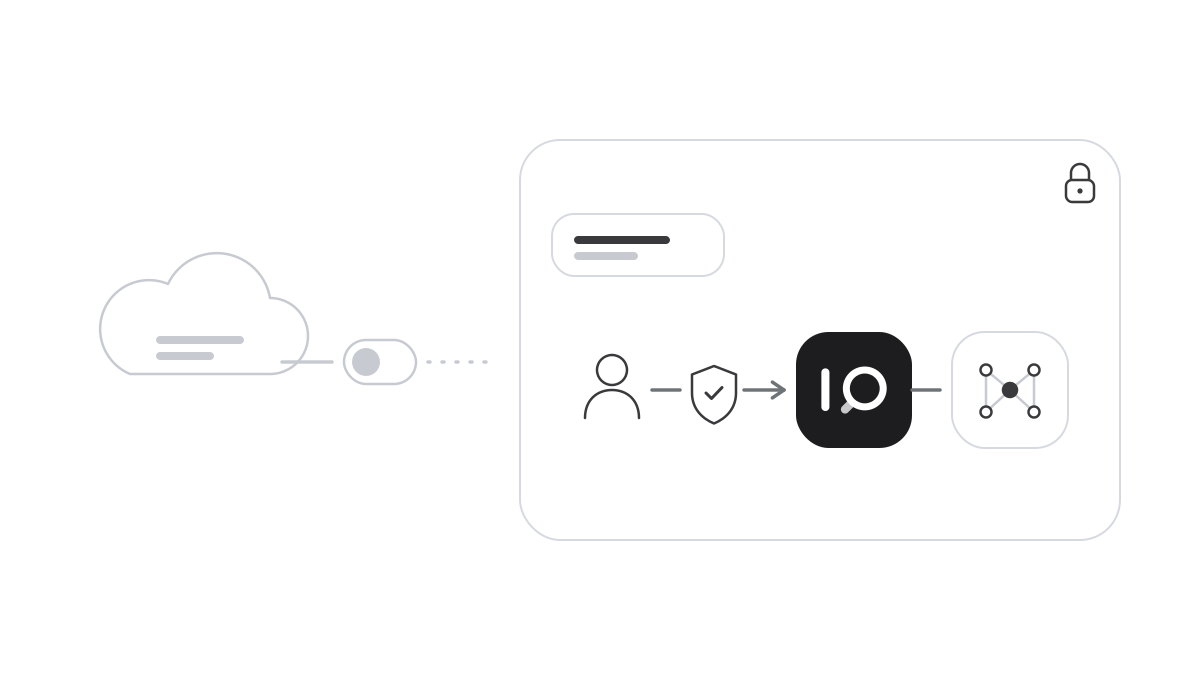
One way to reduce the risk of an outside party switching the service off is to run the chain yourselves. When the language model and the rest of the chain run in your own environment, you control when it is used and when it is updated. That brings a different responsibility, for operations, updates and backups, and it is a trade-off described in on-premises or cloud. Read more about how well a language model on your own premises performs.
How it works in iSearch
The whole chain can run on your premises, or we run it for you in Sweden. The language model is part of the chain and can run in your own environment, with no public AI services. iSearch then needs no public AI service to work. Every customer gets a separate installation of its own, and data can be exported and deleted per user.
Read more about security in iSearch or book a walkthrough.
Sources: CNBC on the export controls and their lifting (2026)DORA, Regulation (EU) 2022/2554The Data Act, Regulation (EU) 2023/2854
Want to see how it would work for you?
Tell us what you want to solve, and we’ll show you how iSearch can help.