Is a language model on your premises good enough?
Many who want AI in their own environment wonder whether they will have to settle for less. The gap to the largest services has narrowed, and in everyday work other things often matter more than the model.
 iSearch
Contents
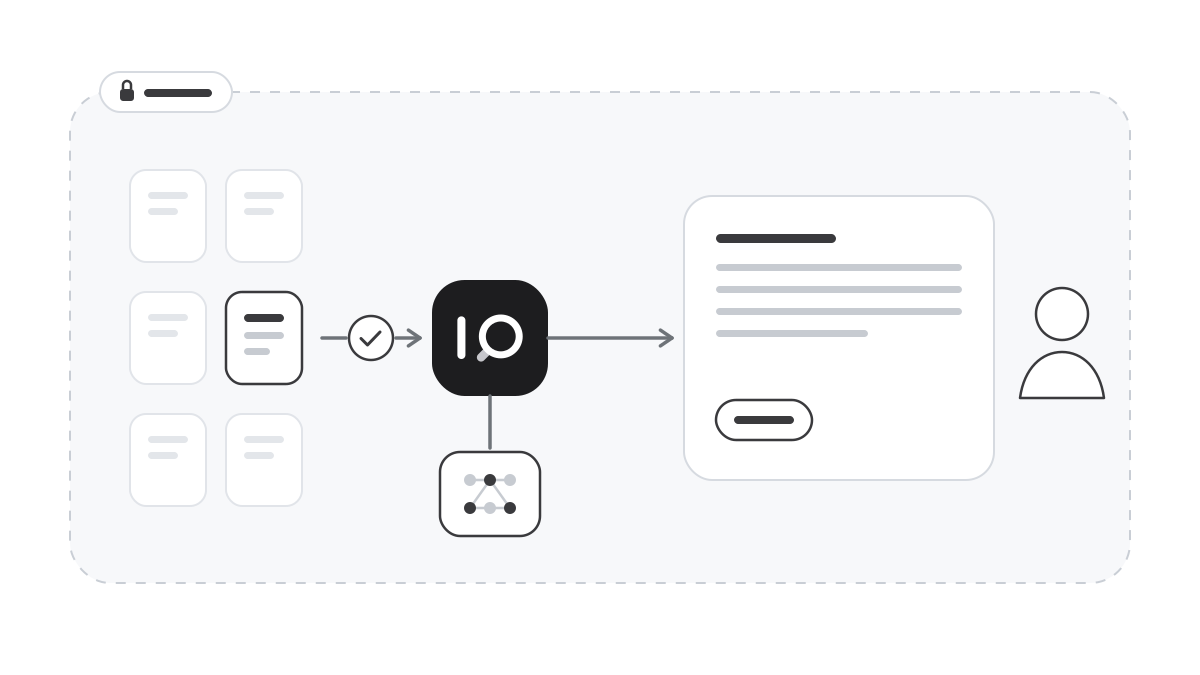
The most common question when an organisation wants to run AI itself is about quality. If the language model runs on your own servers, will the answers be worse than in the large public AI services? It is a fair question, and the answer has changed quickly. A few years ago the gap was wide. Today it is much narrower, and for many tasks at work other things decide how good the answers are.
The gap has narrowed
A language model that can be downloaded and run in your own environment is often called an open model. The research organisation Epoch AI tracks how such models compare with the best models, which are available only as services. In its measurement from May 2026, the best open models have trailed by about four months since the start of the year. What was the best on the market four months ago can, in other words, run on your premises today.
The gap is not the same everywhere. It shows most in long, complex tasks where the model has to plan many steps itself, and in the very hardest questions. It shows least in what fills an ordinary working day: answering questions from procedures, summarising, drafting and rephrasing.
The sources matter more than the model
An internal AI assistant draws most of its knowledge from your own documents when the question is asked, using a technique called RAG. The answer is then only as good as the material. A model that gets the right section of the right procedure answers better than a stronger model that gets the wrong section or none at all.
So it pays to spend time on what surrounds the model: which documents the assistant reads, that they are up to date and that every answer shows which documents it is based on. An answer with a source can be checked, whichever model wrote it. That is also what guards against AI making things up.
What running it yourself requires
A model in your own environment needs hardware that is up to the job. Larger models often give better answers but need more, and the choice is a balance between quality, response time and cost. A smaller model chosen for the task is often enough.
The model also needs looking after. New versions arrive often, and every new model should be tried against your own questions before it is put to use. A model in your own environment does not change without you knowing. That is a strength when the work requires predictable answers.
Test with your own questions
The best way to decide whether a model is good enough is to try it on the work it will do. Collect twenty to thirty real questions from your organisation, with answers that an experienced colleague has approved. Let the assistant answer and compare. Check whether the answers are right, whether the sources are correct and whether it says so when the material is missing.
A test like this says more about your work than general comparisons between models. It also gives you a baseline to return to when a new model is to be tried.
How it works in iSearch
The whole chain can run on your premises, or we run it for you in Sweden. The language model is part of the chain, and we choose models that suit your organisation and your requirements. Every answer shows which documents it is based on, and if the material is missing, the answer says so. Your data is never used to train models.
Read more about offline AI and security in iSearch, or book a walkthrough.
Sources: Epoch AI, Open models lag state-of-the-art closed models by 4 months (2026)
Want to see how it would work for you?
Tell us what you want to solve, and we’ll show you how iSearch can help.