The difference between internal AI and public AI services
Public AI services have made AI something everyone can use. That is a good thing. But when the questions concern your organisation's own data, it is worth understanding where the differences lie, without dramatising them.
 iSearch
Contents
Public AI services are impressive. They write, summarise and explain in seconds, and they have shown a great many people what AI can do. For general questions, for rephrasing a text or for learning something new, they are often an excellent tool.
The question is not whether public AI services are good or bad. It is what they are built for, and what happens when they are used for things they were not built for. That becomes clear in three situations.
When the question contains your data
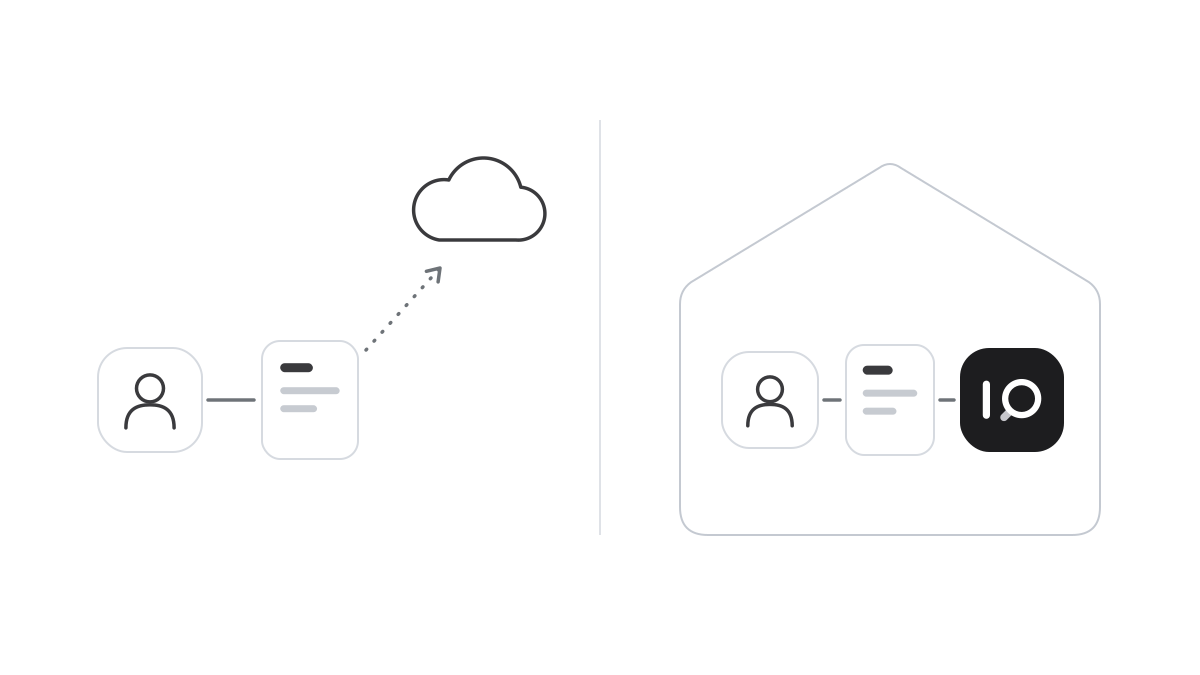
A public AI service runs at a supplier, outside your organisation. Whatever is typed in is sent there. For a general question, that does not matter. For a customer email, a contract or a note from an HR case, it does.
Terms differ between services and between plans, and they can change over time. Some allow content to be used to improve the service, others do not. What matters is not what a particular supplier does today. It is that organisations rarely have an overview of which services are in use, by whom and on what terms. For personal data, that quickly becomes a GDPR question.
An internal AI works in a different way. It runs in your own environment, or in a separate installation that is yours alone. Questions and documents stay there and are never used to train models. When the whole chain runs with you, nothing is sent to an external AI provider. We describe what happens when staff paste sensitive data into AI in the article on sensitive information in AI.
When the answer should reflect your organisation
A public AI service answers from general knowledge. It knows how things are usually done, but not how you do them. Ask about your holiday policy or your complaints routine and you get a reasonable answer about how it often looks. The service does not know what applies to you.
An internal AI answers from your own documents. It reads your routines, templates and handbooks and shows which documents the answer is based on. That makes answers both more accurate and possible to check. Staff can open the source and see for themselves, and everyone gets the same answer from the same material.
When not everyone should see everything
A public AI service knows nothing about your permissions. It has no idea that payroll data is for HR only or that a customer file should only be seen by the case handler. That is irrelevant as long as it has no access to your documents, but it also means it cannot help with them.
An internal AI can follow your rules. Staff sign in with the account they already have, using SSO and MFA. The role decides which material each person reaches, so the assistant never answers from something the user is not allowed to see. Everything that happens is written to a tamper-evident audit log that can be connected to your SIEM.
None of this means public AI services should be banned. It means they suit some tasks, and that your organisation’s own data needs a tool of its own. When that tool is just as easy to use, the reason to mix them up disappears.
How it works in iSearch
iSearch is an internal AI. The whole chain can run in your own environment, or in a separate installation that we run for you. Questions and documents stay with you and are never used to train models.
The assistants answer from your own knowledge banks and show which documents were read. SSO, MFA, role-based access and a tamper-evident audit log are included.
Read more about security, about offline AI in your own environment or book a walkthrough.
Want to see how it would work for you?
We’ll show you iSearch with your own documents.