When is an AI answer an official document?
A question put to an AI tool and the answer that comes back are information too. For a Swedish public authority, that raises the question of what counts as an official document, and who can ask to see it.
 iSearch
Contents
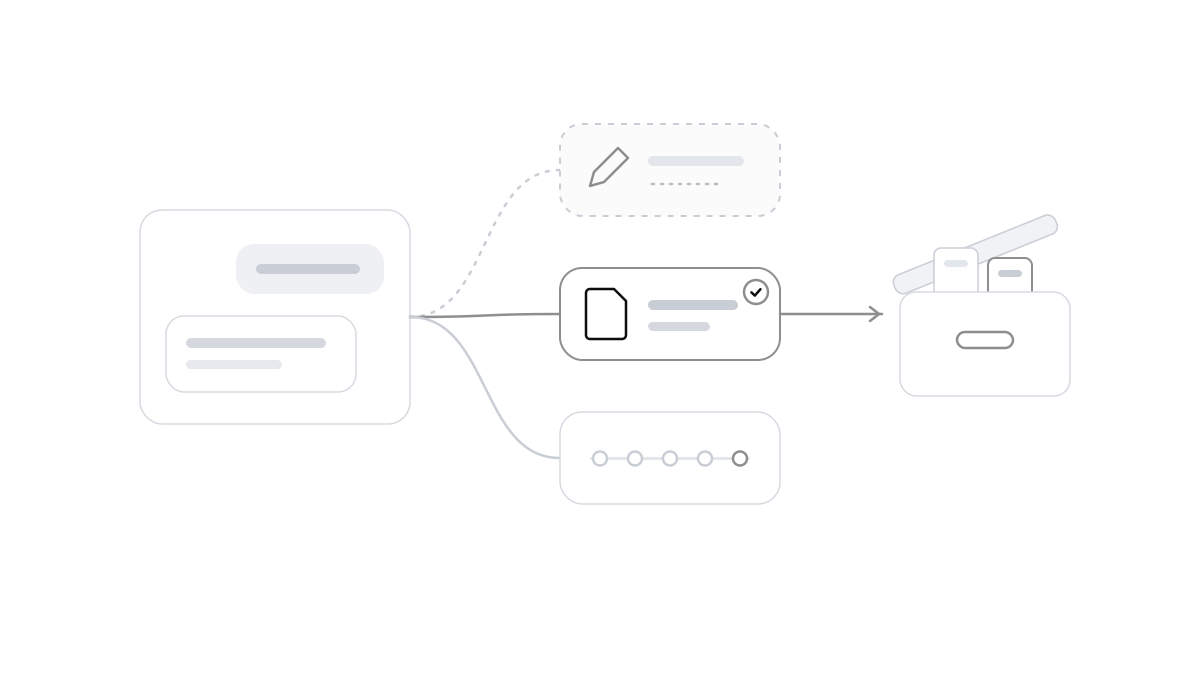
A case officer asks an AI assistant to summarise a case and gets back a draft file note. A colleague pastes in a question from a member of the public and gets a suggested reply. The question and the answer then remain somewhere, in the tool, in a log or with a supplier. For a Swedish public authority, that raises a question private companies rarely have to ask. Are these official documents, and if so, who can ask to see them?
What the Freedom of the Press Act says
Sweden’s principle of public access rests on the Freedom of the Press Act. A document is official if it is held by a public authority and is regarded as received by it or drawn up there. The notion of a document is broad. It also covers recordings that can only be read with technical aids, such as a saved conversation or a log, provided the authority itself can retrieve them.
A document that is not sent out is regarded as drawn up once the matter has been finally dealt with, or once the document has been approved or otherwise finalised. As a rule, drafts and memoranda that have not been dispatched are not official, unless they are kept for the archive. That exception does not apply to a memorandum, however, to the extent that it adds a fact to the matter.
The Act also has a rule on technical processing. A measure taken solely as part of the technical processing or technical storage of a document provided by an authority does not make the document count as received by whoever carries out that measure.
The prompt, the answer and the log
Digg and IMY, the Swedish agencies for digital government and for data protection, have issued guidelines on generative AI in public administration. They consider that the prompt and the input are likely to be regarded as a form of draft. What the tool produces is more likely to be regarded as drawn up and finalised, and may then be an official document.
The wording is cautious, and the assessment depends on how the answer is used. A suggestion that helps someone rephrase a sentence is close to a draft. A compilation used as the basis for a decision adds something to the matter and has a different standing. Logs can be official documents too, and the same rules on disclosure, confidentiality and archiving then apply as for other documents.
When information leaves the authority
Using an AI tool from an outside supplier usually means handing information to someone else. According to the guidelines, that in itself can count as disclosure. For information covered by confidentiality, there must then be a legal basis. Since July 2023, Swedish law has had such a provision for arrangements in which the supplier only processes or stores the information technically on the authority’s behalf, as long as that is not inappropriate in the circumstances.
Whether a particular AI service falls within that depends on the contract, on how the service works and on what it is used for. Digg also points out that what the authority puts in must not risk becoming training data for the service. The assessment therefore needs to be made before the tool is taken into use, and documented. Public AI services that staff use on their own initiative often fall outside that assessment entirely, and that is part of what is known as shadow AI.
An inquiry is reviewing the rules
In September 2026 the Swedish government appointed a special investigator to analyse how the principle of public access applies when authorities use AI and external cloud services. Among other things, the inquiry is to assess to what extent information generated or stored with such tools amounts to official documents, and how public scrutiny is affected. It is to report by 15 November 2027.
Until then the current rules apply, and every request to see a document is considered on its own merits. What can be done now is to know where questions, answers and logs are kept, how long they are retained and who can retrieve them. An authority with that overview can handle a request, and the confidentiality assessment, in the same way as for any other document.
How it works in iSearch
The whole chain in iSearch can run in the authority’s own environment, the language model included. Every customer gets a separate installation of its own, and your questions and documents are never used to train models. Every answer shows which documents were read, and a tamper-evident audit log shows who did what. Retention is set per type of data, and data can be exported and erased per user.
Read more about AI in the public sector and cloud services and confidentiality, or book a walkthrough.
Sources: Freedom of the Press Act, Chapter 2 (riksdagen.se, in Swedish)Public Access to Information and Secrecy Act, Chapter 10 Section 2 a (riksdagen.se, in Swedish)Digg and IMY, Ensuring confidentiality when using generative AI (2026, in Swedish)Digg, Official documents and public access in logging (2026, in Swedish)Government of Sweden, Terms of reference 2026:116 on public access and AI (2026, in Swedish)
Want to see how it would work for you?
We’ll show you iSearch with your own documents.