Confidential, accountable AI in the public sector
The public sector has a lot to gain from AI. Case handling, services and internal routines rely on large amounts of documents. Citizens hand over their data because they have to. So the authority must be able to show where that data is, who has read it and that it has not left the organisation.
 iSearch
Contents
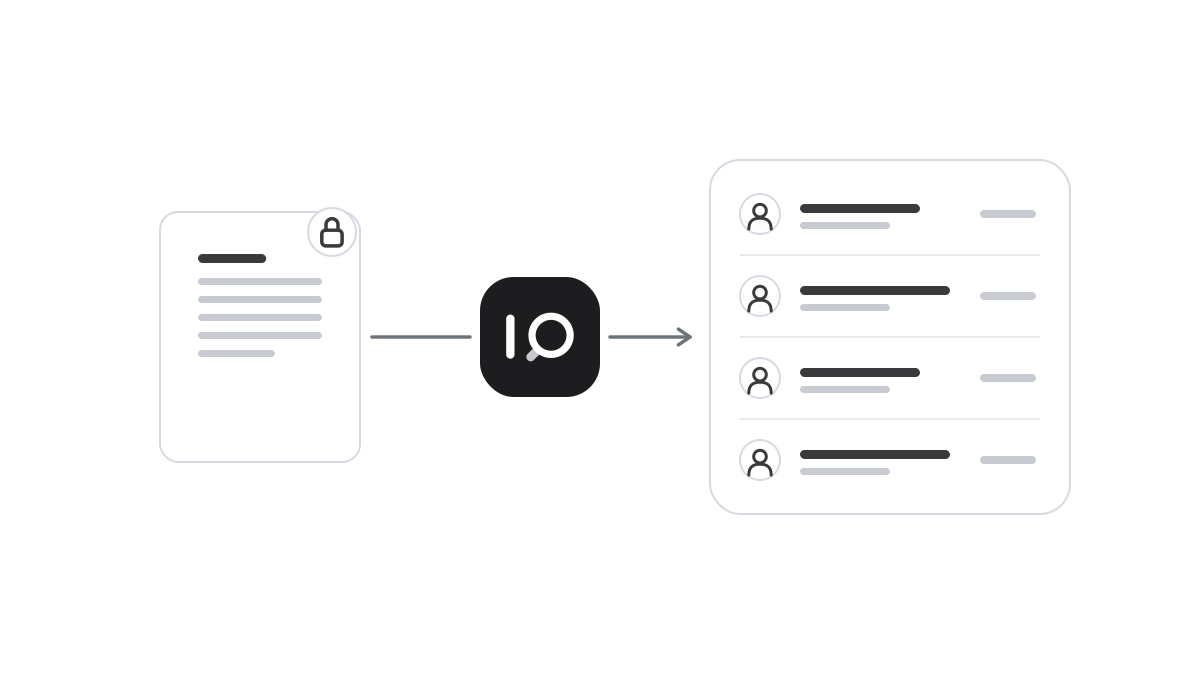
A case handler at a municipality has a case in front of her she has not seen before. She knows there is a routine, perhaps a similar decision from last year, but not where. She asks a colleague, who is in a meeting. She searches the intranet and gets forty results. Half an hour later she has found the right one.
Half hours like that are everywhere in the public sector. Municipalities, regions and authorities work with rules and routines that must apply equally to everyone, and much of the working day goes into finding the right material. That is exactly where AI can help. At the same time, the data concerns citizens, much of it is confidential and every decision must be justified.
The value is concrete
An assistant that answers from the organisation’s own documents gives the case handler the right routine in seconds, with a reference to the document. Front-line staff get support to give correct answers. New colleagues get the same answers as experienced ones, in their very first week. And questions about HR, finance and administration can be answered without anyone having to interrupt their work.
When answers come from the same material, decisions become more consistent too. Two case handlers asking the same question find the same routine, and in the public sector that is also a requirement of equal treatment.
Where data is processed
The first question is always the same. Does anything leave the organisation? When an AI service runs at an external supplier, questions and document excerpts are sent there. That requires contracts, assessments and trust in how someone else handles the data, and for confidential information it can be an obstacle.
With your own installation, the software, the documents and the language model sit in your environment. Air-gapped, the environment also has no internet connection. No data needs to leave the organisation, and when citizens or supervisors ask where the data is, the answer is simple: with you.
Under GDPR, personal data must be processed for a clear purpose and not kept longer than necessary. That applies when AI is used too. Retention should be controllable per type of data, data should be exportable and erasable per user, and legal hold is needed when something must be preserved. Your data should never be used to train models.
Accountability stays with people
AI can produce material, a draft or an answer. But responsibility for the decision stays with the case handler and the authority. So it must be clear that an answer is support, and it must be possible to see what it is based on. When every answer refers to its documents, the case handler can check the material, and the decision can be justified.
Access needs to follow the same rules as other systems. Staff sign in with SSO and MFA, the role decides which material each person reaches, and sensitive changes need approval from two people. A tamper-evident audit log that connects to your SIEM means you can always follow up who did what.
Internal routines are a good place to start. They rarely contain data about individuals and the need is large. You get to see that permissions, logging and source references work as intended before cases with personal data come in. Then take the next area, one at a time.
How it works in iSearch
The whole chain in iSearch can run in your own environment, fully isolated with an air gap when required. Every customer gets a separate installation of its own, and every answer shows which documents were read.
SSO, MFA, role-based access, the four-eyes principle, a tamper-evident audit log and legal hold are included. Traffic is protected with TLS and stored data with AES-256. Data can be exported and erased per user, and it is never used to train models.
Read more about security, see how iSearch is used or book a walkthrough.
Want to see how it would work for you?
We’ll show you iSearch with your own documents.