Protective security and AI: what to consider
AI can support security-sensitive work too. When the data is covered by protective security, though, special rules govern how systems are built, procured and run.
 iSearch
Contents
Sweden’s Protective Security Act applies to anyone carrying out activities of importance to Sweden’s security. That can be government agencies, municipalities and regions, but also companies in sectors such as energy, transport and defence. AI can support that work too, for example by helping staff find their way through extensive rules and procedures. When the data is covered by protective security, the law governs how systems may be built and who may access them.
This article is an overview and not legal advice. Responsibility lies with the organisation, and the work is led by the protective security manager. In some cases you must also consult the Security Service or your supervisory authority.
The Security Service on AI
In June 2026 the Swedish Security Service wrote about how new AI models affect cyber security. It stresses the ability to detect, prioritise, contain, seal off and recover quickly, and reminds organisations of the rules on logical and physical separation and one-way communication. Under the Security Service’s regulations, information systems for information classified secret or above must be physically separated from systems without equivalent protection. The Security Service also recommends backups that are isolated and cannot be altered.
The Security Service’s message is that the developments make it even more important to work actively with the protective security analysis and the measures that follow from it.
Before an AI system goes into operation
The foundation is the protective security analysis. It sets out which information and which activities need protecting, and against which threats. An AI system that is to read such information becomes part of that picture.
Before an information system of importance to security-sensitive activities goes into operation, the Protective Security Ordinance requires a specific protective security assessment. In it you determine which security requirements the system must meet. For an AI system, that includes where the language model runs, which documents it may read, who may use it and how updates are brought in. If the system is to handle information classified confidential or above, you must consult the Security Service before it goes into operation or is substantially changed, and the system must be approved before it is used.
Bear in mind, too, that an AI assistant is good at bringing information together. Pieces of information that are harmless on their own can together reveal something that needs protecting. Include in the assessment which sources are connected and what answers they could produce together. Permissions and logging belong here as well. Only people with both authorisation and a need should reach the information, and it should be possible to trace who did what.
When a vendor may gain access
If a vendor may gain access to information classified confidential or above, or to other security-sensitive activities of equivalent importance, a protective security agreement is required. Before the procedure begins, you must carry out a specific protective security assessment and a suitability examination. From secret upwards, you must also consult the supervisory authority.
An AI service run by an external vendor asks more of the assessment, because the data may then be processed outside your control. The less a vendor can reach, the simpler the assessment. The EU AI Act does not apply to AI systems used exclusively for military, defence or national security purposes. A system that is also used for other purposes is covered. The Protective Security Act applies in both cases.
How it works in iSearch
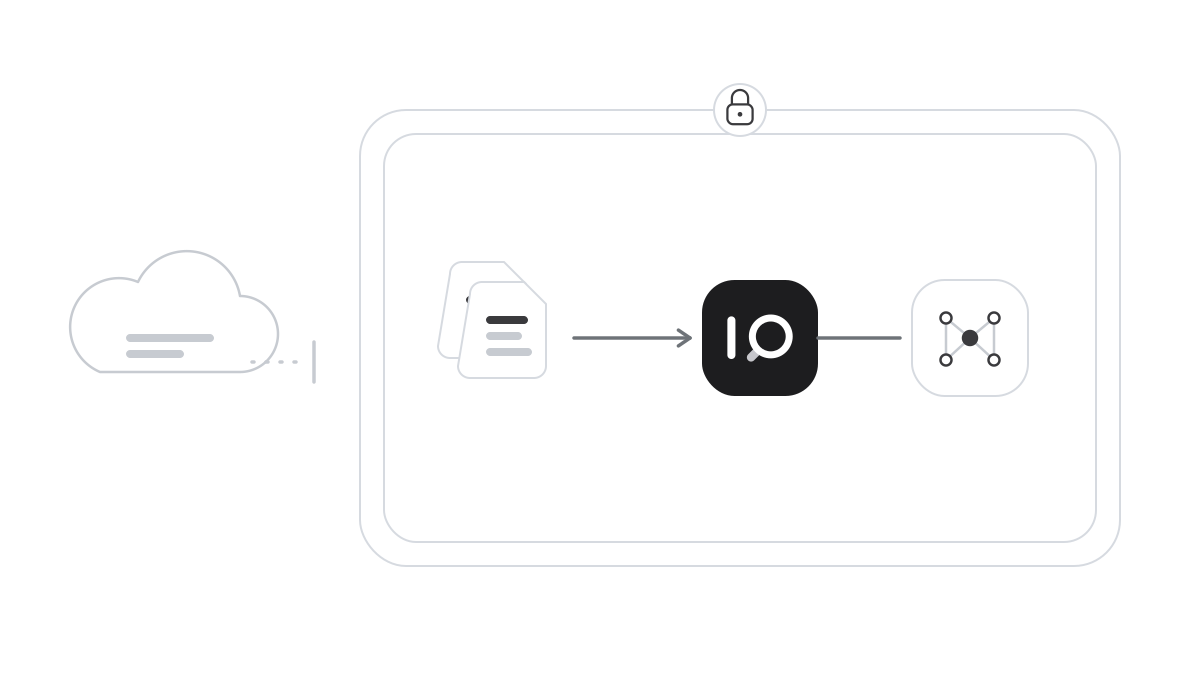
The whole chain can run in your own environment, the language model included, and even fully isolated with an air gap when required. When iSearch runs on your premises, passwords and keys are stored in your own installation. Updates are signed, for fully isolated environments too, and an SBOM, a list of all components, shows what is included.
Read more about AI for strict confidentiality and security in iSearch, or book a walkthrough.
Sources: Swedish Protective Security Act (2018:585, in Swedish)Swedish Protective Security Ordinance (2021:955, in Swedish)Swedish Security Service, the impact of AI models on cyber security (2026, in Swedish)Swedish Security Service regulations on protective security (PMFS 2022:1, in Swedish)EU AI Act, Regulation (EU) 2024/1689
Want to see how it would work for you?
Tell us what you want to solve, and we’ll show you how iSearch can help.