AI transcription and the GDPR: what IMY has said
AI that transcribes and summarises conversations can save a great deal of time. In 2026 the Swedish Authority for Privacy Protection set out for the first time what it requires. Here is what applies and what you can prepare.
 iSearch
Contents
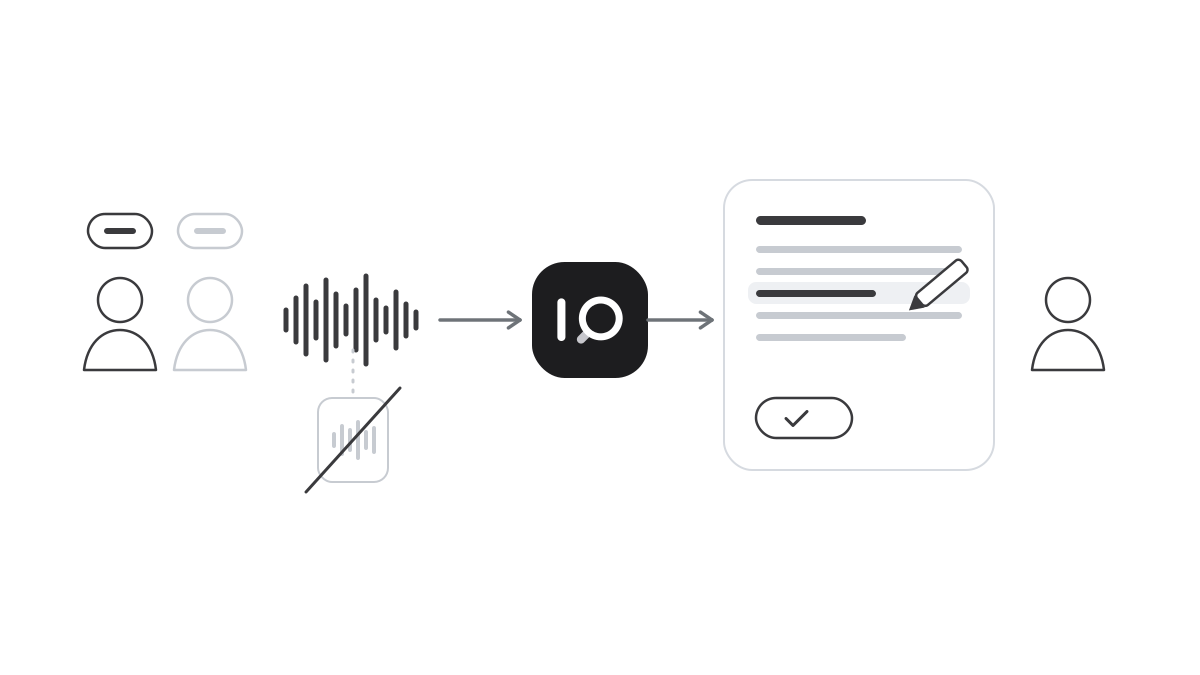
Documentation takes up a large part of the working day in many professions. After a conversation, the key points have to be written down, often from memory and often late. AI can record the conversation, transcribe it with speech recognition and produce a draft note. At the same time, conversations often contain personal data, and in healthcare and social services that data is often sensitive. In 2026 the Swedish Authority for Privacy Protection, IMY, set out for the first time what it requires.
What IMY has assessed
In April 2026 IMY published a report from its innovation sandbox, where it had given Kalmar municipality in-depth guidance for six months. The municipality wanted to use an AI service that records conversations between social workers and the people they meet and produces transcripts and summaries. The drafts are reviewed and finalised by the social worker before they are used as a basis for decisions.
IMY found that there is a legal basis for the processing under the GDPR, including for sensitive personal data. At the same time it stressed that the processing must be necessary and proportionate. The assessment concerns social services, but the questions are the same in many organisations where conversations are documented.
Review and security
A transcript can be wrong. Words can be misheard, and a summary can leave out something important. IMY therefore places great weight on human control. The person documenting must be able to review and correct what the AI has produced, and that takes training, time and support. IMY warns that limited knowledge of AI, too much trust in the system or gaps in the organisation can lead to errors.
That means review has to fit into the working day. A tool that saves time on writing but leaves too little time for reading through has not solved the problem.
IMY also points to security. There need to be clear routines for deleting data that is no longer needed, encryption in transit and at rest, strict access control and logging with regular checks.
The audio is often the most sensitive part. Once the transcript has been reviewed, the recording is rarely needed, and what is not kept cannot leak.
The review in primary care
In May 2026 IMY opened a supervisory review of how Region Gävleborg uses AI transcription in primary care. It includes an on-site inspection and concerns whether the region has the technical and organisational measures the GDPR requires. Among other things, IMY is examining whether there is an organisation for correcting errors in the transcription and how the region avoids unintended changes to the AI model over time. The review is ongoing, and no decision has been made yet.
Questions to ask before you start
Ask where the audio is processed and whether it leaves your environment. Ask how long audio and text are kept and who can see them. Ask how errors are found and corrected, and who is responsible for the final text. Ask too what happens when the model is replaced or updated, and how you will be told. More questions about personal data are in GDPR and AI: the questions to ask your supplier.
How it works in iSearch
In iSearch you can record a meeting and get minutes with the decisions and who is responsible. Several speakers are told apart, and the audio is deleted once the transcript is done. In healthcare, the doctor dictates after the appointment and gets a draft based on the practice’s own templates. The person who was there reviews the text and is responsible for it.
The whole chain can run on your premises, or we run it for you in Sweden. Role-based access, retention periods per type of data and a tamper-evident audit log are included. Your data is never used to train models.
Read more about secure AI in healthcare or book a walkthrough.
Sources: Swedish Authority for Privacy Protection, transcription in social services (2026, in Swedish)Swedish Authority for Privacy Protection, supervision of Region Gävleborg (2026, in Swedish)General Data Protection Regulation (GDPR), Regulation (EU) 2016/679
Want to see how it would work for you?
Tell us what you want to solve, and we’ll show you how iSearch can help.